3D Printing platform for engineers, manufacturers, and innovators.
Engineering-Driven 3D Printing
We combine advanced 3D printing, and real-world manufacturing expertise to remove friction from prototyping and production.
Upload your file. Get instant pricing. Move from concept to production without delays.
3D printing for manufacturing is not about hobby machines or one-off prototypes anymore — it is a production tool that is solving real engineering, supply chain, and cost problems across industry.
At its core, 3D printing (additive manufacturing) builds parts layer by layer directly from a digital file. That removes the need for tooling, reduces setup time, and allows you to move from design to physical part faster than traditional methods ever could.
Where this becomes powerful is in manufacturing environments. Instead of waiting weeks for tooling, moulds, or outsourced machining, parts can be produced on demand — whether that’s a one-off component, a small production run, or a functional end-use part.
It is particularly effective where complexity is high, volumes are low to medium, or speed matters. Internal geometries, lightweight structures, and design iterations that would be difficult or impossible using traditional manufacturing become straightforward.
From a business perspective, it changes how you think about production. You are no longer locked into minimum order quantities, expensive tooling, or long lead times. You gain flexibility, reduce risk, and bring control back into your process.
In short, 3D printing for manufacturing is not a replacement for everything — but where it fits, it gives you speed, control, and capability that traditional processes simply cannot match.
USE OUR CHAT TO EXPLORE THE ENGINEERING KNOWLEDGE BASE
Refresh the page after you have asked the question
Industries We Support
3D printing is not tied to one sector — it is a problem-solving tool used across industries where speed, flexibility, and precision matter. At its core, it enables businesses to move from concept to physical part without the traditional constraints of tooling, long lead times, or high upfront costs. This makes it particularly valuable in environments where rapid iteration, customisation, and performance are critical to success.
In engineering and manufacturing, 3D printing allows teams to develop, test, and refine components at a pace that would be impossible with conventional methods.
Design changes can be implemented immediately, reducing downtime and accelerating product development cycles. For industries such as automotive, aerospace, and marine, this means faster innovation and the ability to produce complex geometries that improve performance while reducing weight.
In architecture and construction, it provides a practical way to visualise concepts through detailed scale models, helping stakeholders better understand designs before committing to full-scale builds.
In the medical and healthcare sectors, it supports the creation of bespoke components, from prosthetics to surgical guides, tailored to individual needs with a high degree of accuracy.
Beyond heavy industry, 3D printing is equally valuable in consumer products, product design, and small-scale manufacturing.
It enables low-volume production runs, on-demand manufacturing, and the ability to bring niche or specialised products to market without the financial risk of traditional production methods.
Ultimately, 3D printing is not just a manufacturing method — it is a strategic tool. It removes barriers, shortens development timelines, and gives businesses the freedom to innovate without compromise. Regardless of the sector, the advantage remains the same: faster decisions, better products, and a more agile approach to production.
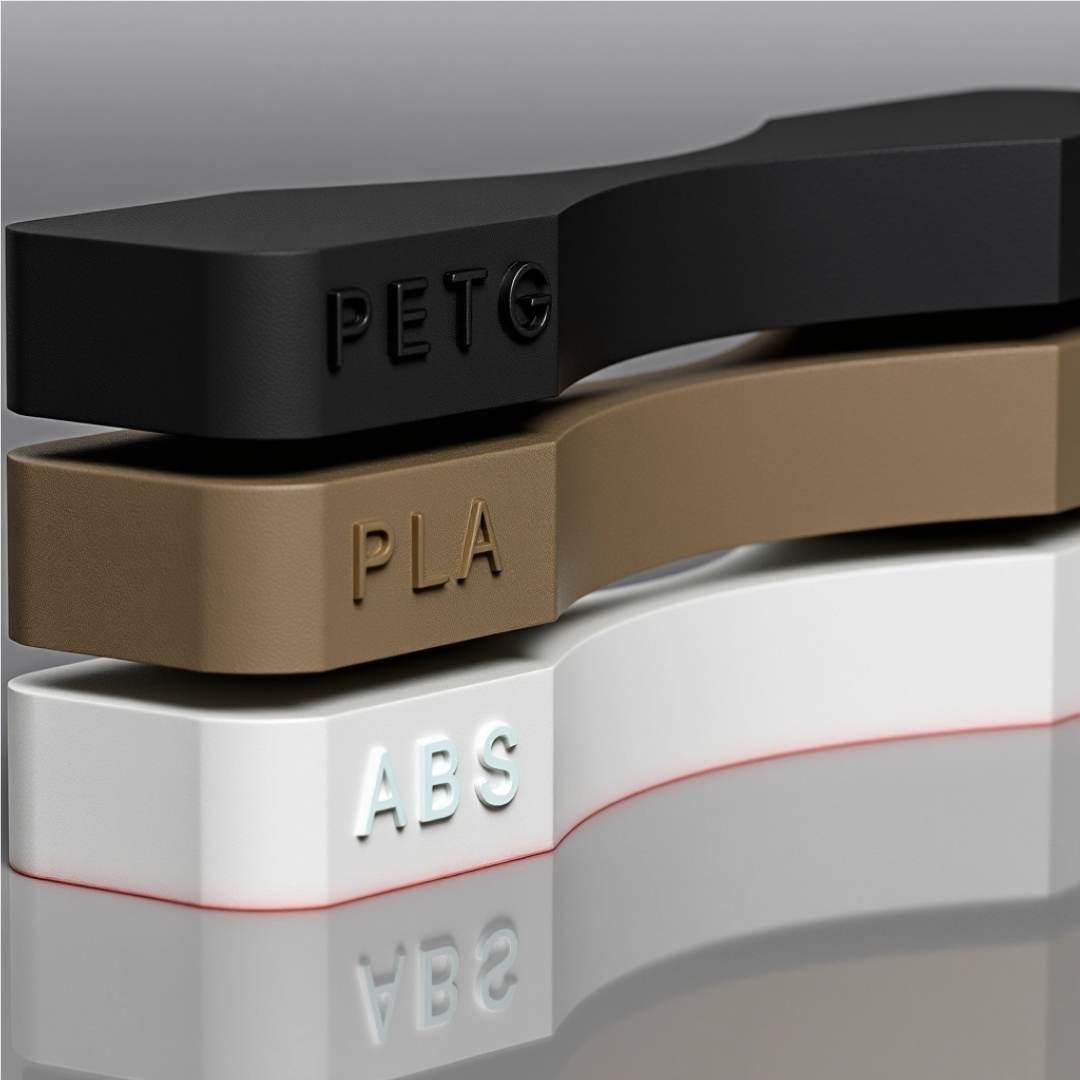
Material choice is one of the most important decisions we make, and it is never guessed. ABS, PETG, nylon, and reinforced engineering plastics all behave differently under load, heat, UV exposure, and repeated movement. ABS is strong and durable but will degrade outdoors over time. PETG offers improved UV resistance and flexibility. Nylons provide strength and wear resistance where movement and friction are involved. Reinforced materials are used where stiffness and dimensional stability matter. We explain these differences clearly so customers understand why a particular material is recommended and what trade-offs exist. For emergency replacements, the goal is often to restore function quickly without creating another failure point. Where parts are expected to remain in service long-term, durability and lifespan are prioritised instead.
Materials Explained:
Materials are where 3D printing becomes engineering, not just production.
Each material has its own mechanical properties, finish, and use case. Choosing the right one is not optional — it directly impacts performance, durability, and cost.
PLA (Polylactic Acid) :
Best suited for visual models and light-use parts. Easy to print, cost-effective, but not designed for high stress or temperature environments.
ABS :
Stronger and more heat-resistant than PLA. Suitable for functional prototypes and parts that need durability without moving into engineering-grade materials.
PETG:
A balance between strength and flexibility. Good for functional parts where impact resistance and chemical resistance are required.
Nylon (PA12):
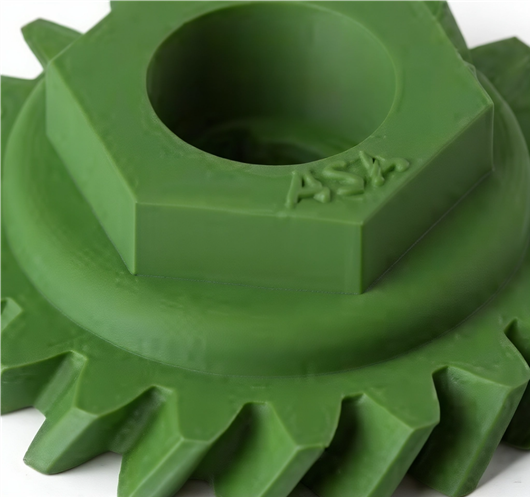
An engineering-grade material. Strong, flexible, and wear-resistant. Used for functional components, mechanical parts, and assemblies.
Resin (SLA) :
High-detail, smooth finish. Ideal for intricate parts, visual prototypes, and applications where surface quality matters.
Composite Materials:
Carbon fibre or glass-filled materials offer increased stiffness and strength. Used in applications where weight and performance are critical.
The key is simple: material selection should be driven by use-case, not convenience.
Cost of 3D Printing UK
The cost of 3D printing is not a fixed price — it’s a calculation.
It depends on several key factors:
Material usage (volume and density)
Print time (machine hours)
Labour and setup
Post-processing requirements
Quantity
Unlike traditional manufacturing, there are no tooling costs — but that doesn’t mean every part is cheap.
For small batches, prototypes, and complex geometries, 3D printing is often more cost-effective than machining or injection moulding. For high-volume production, traditional methods may still be more economical.
What matters is understanding where it fits.
If you’re producing one-off parts, custom components, or low-volume runs, 3D printing reduces upfront investment and speeds up delivery.
If you’re producing thousands of identical parts, other methods may be more suitable.
It’s not about price alone — it’s about total cost of production, time, and flexibility.
For procurement teams, predictability matters. Short-run production is handled with consistency so repeat orders behave the same way each time. Once a part has been proven in service, producing replacements becomes quick and reliable. This is particularly useful where legacy equipment is still operational but no longer supported by the original manufacturer. Additive manufacturing allows businesses across Hampshire and the South Coast to extend the life of assets without redesigning entire systems. It also allows design improvements to be made incrementally, addressing known weak points without committing to full retooling. This flexibility is one of the main reasons emergency and industrial 3D printing has become a practical manufacturing tool rather than a last resort.
Based in Southampton, Mitchell & Son supports businesses throughout the Solent region that need fast, sensible manufacturing solutions. Injection moulding has its place, but the upfront costs often run into thousands before a single part is produced. For low-volume, emergency, or discontinued components, additive manufacturing is often the only commercially sensible option. We also offer post-processing where required, including sanding, surface finishing, and reinforcement, to improve durability or appearance when needed. These services are optional and applied only where they add real value. The objective is always the same: produce a part that works properly, fits correctly, and does its job without becoming the next problem.
Everything we do is driven by real-world use. If a part is ornamental, it can be produced cheaply and quickly. If a part is handled daily, subjected to force, or critical to safety, it is built accordingly. We do not oversell materials or processes that are unnecessary, and we do not underspec parts that will fail prematurely. This approach has allowed us to support manufacturers, engineers, restorers, and maintenance teams across Southampton and Hampshire with solutions that make practical and financial sense. When something breaks, the priority is getting it working again reliably, not experimenting with technology for its own sake.
If you are dealing with a breakdown, an obsolete component, or a supply issue that cannot wait, emergency 3D printing provides a fast and flexible solution. By combining practical experience, CAD capability, and material knowledge, we are able to produce functional parts without the cost and delay of traditional manufacturing methods. This is what we do every day, and it is why customers return when the next problem arises. The goal is not just to print a part, but to solve the problem that caused the failure in the first place.