

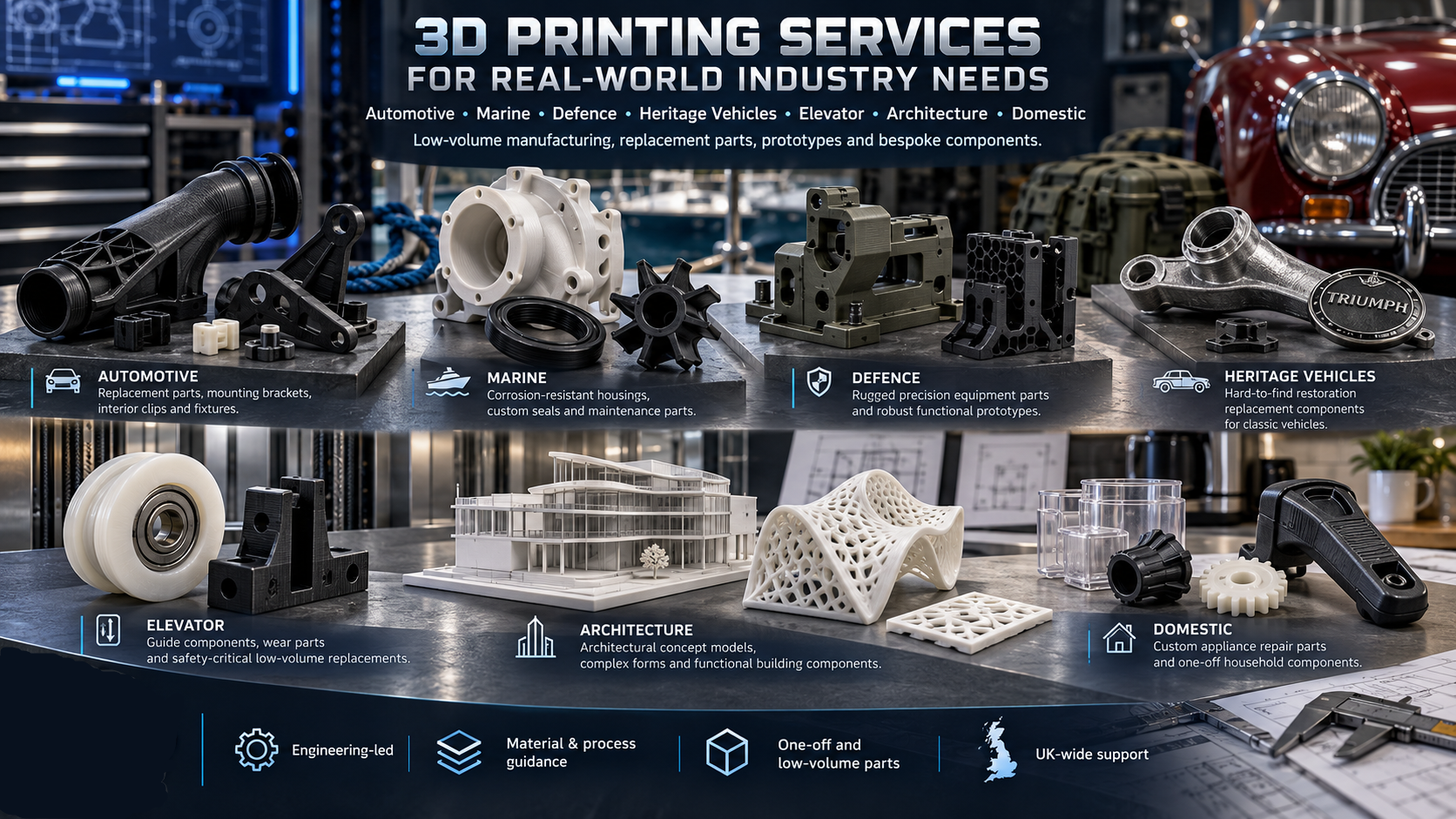
3D Printing for Real-World Industry Needs
We work with organisations that need dependable, low-volume manufacturing, replacement parts, or bespoke components that traditional supply chains cannot provide quickly enough. Our experience spans industries where reliability, small batch production, and rapid turnarounds are essential.
- Automotive: replacement parts, mounting brackets, interior components and engineering fixtures
- Marine: corrosion-resistant housings, custom seals, and bespoke maintenance components
- Defence: rugged, precise parts for equipment, fixtures, and rapid prototyping
- Heritage Vehicles: hard-to-find replacement components for restoration projects
- Elevator: wear parts, guide components and low-volume safety-critical replacements
- Architecture: concept models, complex forms and functional building components
- Domestic: custom parts for appliances, property repairs and one-off household components
Small Batch Production and Replacement Parts
Many industries require low-volume production or single-item replacements, where traditional supply chains are too slow or expensive. Additive manufacturing allows these parts to be made on demand, reducing downtime and avoiding costly over-ordering.
What Each Sector Usually Needs
These are not marketing categories. Each sector tends to arrive with a different kind of problem, and the same process choice rarely suits all of them.
- Automotive. Jigs, fixtures, brackets, trim clips and under-bonnet parts where heat and oil resistance matter, plus prototypes for fit checks before tooling is committed.
- Marine. Brackets, mounts and covers that have to survive salt and UV, and replacement parts for equipment whose original supplier has moved on.
- Defence. Low-volume housings, mounts and training aids, often to a drawing with tight fit requirements. Anything safety-critical goes to engineering review.
- Elevator and lift. Wear parts, guides and covers. Where a component forms part of a safety system it is reviewed by an engineer before production and is not treated as a like-for-like swap.
- Heritage and classic vehicles. Parts that exist only as a broken original or a photograph, where reverse engineering is the whole job rather than an afterthought.
- Architectural. Concept models, complex forms and one-off components where the geometry is the point and tooling would be wasted.
- Domestic and property. Appliance parts, fixings and one-off repairs where the alternative is replacing an otherwise serviceable item.
- Industrial tooling. Soft jaws, nests, gauges and handling aids, usually needed quickly and in small numbers.
How We Work With Trade and OEM Customers
Most of the work behind these sectors is not a one-off. A part is needed, it works, and then it is needed again next quarter, or in a slightly different size, or in a batch of twenty.
- Repeatable files. Once a part has been modelled and produced, the file becomes the asset. Reorders do not start again from a photograph.
- Drawing-based work. Where a drawing exists, parts are made to it, and any dimension we cannot hold is raised before production rather than after.
- Batch economics. MJF suits runs of identical nylon parts, FDM suits single functional parts and large simple geometry, and SLA suits fine detail and smooth surfaces.
- Material consistency. Staying with one material across a family of parts avoids the surprise of a substitute that behaves differently in service.