

The Right Composite Plastic for Your Application
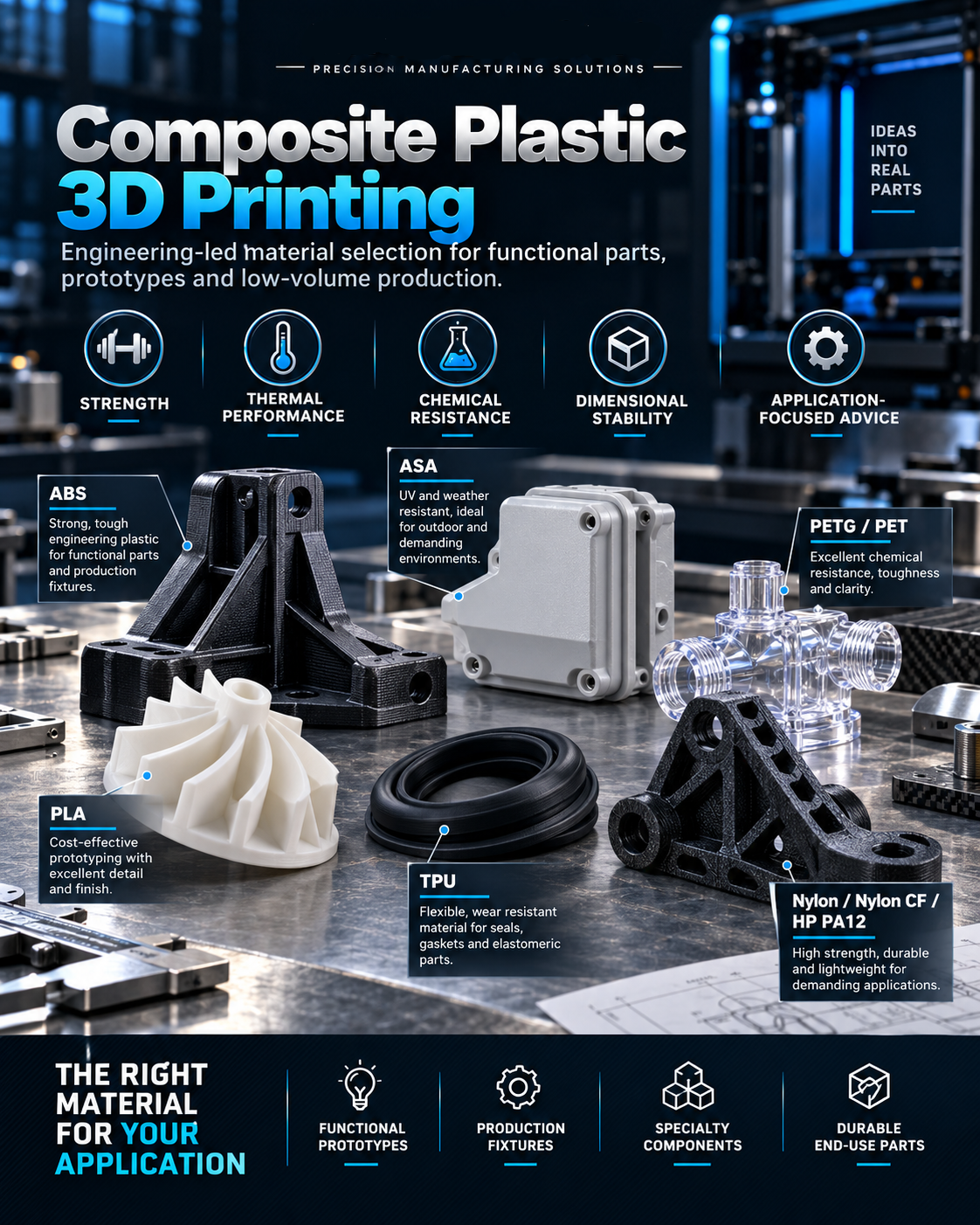
Composite plastic materials are selected for strength, thermal performance, chemical resistance, and dimensional stability. The right choice depends on the part’s end use, the environment it will work in, and whether it needs to be tough, flexible, or weather-resistant.
At Mitchell & Son, we help customers match technical requirements to the most suitable material. That means choosing the best solution for functional parts, production fixtures, specialty components, and durable prototypes.
- ABS: tough and impact resistant for durable engineering parts
- ASA: weather and UV resistant for outdoor use
- PETG / PET: strong, chemical-resistant, and easy to print
- PLA: quick prototypes and stable models for low-stress parts
- TPU: flexible, elastic, and abrasion-resistant applications
- Nylon / Nylon CF / HP PA12: high-performance engineering materials
Why Composite Plastic Materials Matter
Composite plastic filaments allow modern manufacturing to produce parts that are both functional and economical. They support small production runs, replacement components, and bespoke engineering parts without the time and cost of traditional tooling.
Choosing the right composite material improves part reliability, reduces repair cycles, and gives designers the freedom to create complex shapes that would be difficult with conventional manufacturing.
Key Material Categories We Print
Our composite plastic material range covers standard engineering plastics, weather-resistant polymers, fibre-filled blends, flexible elastomers, and high-performance nylons. This gives us the flexibility to produce parts for a wide range of industries and applications.
- PLA and PLA-CF for quick prototypes and presentation models
- ABS and ASA for impact-resistant, outdoor and engineering parts
- PET and PETG for chemical-resistant, low-moisture applications
- TPU for flexible seals, gaskets and vibration-damping components
- Nylon, Nylon CF and HP PA12 for high-strength, durable production parts
All materials we print
Every material below is available for quoting. If you are unsure which one suits the part, send us the application and we will recommend one.
FDM commodity and engineering grades
- PLA Hyper Speed PLA and PLA Premium. Prototypes, models and light-duty parts.
- PLA CF Carbon-filled PLA including Hyper PLA-CF. Stiff parts, fast.
- PETG PETG Premium. Chemical resistance with good layer strength.
- PET PET Premium. Chemical resistance and a clean finish.
- ABS Hyper Speed ABS and ABS Premium. Tough general-purpose parts.
- ASA ASA Premium. UV-resistant, for outdoor service.
- TPU TPU 95A and Flex TPU 85A. Grips, seals and dampers.
- Polypropylene (PP) Chemical-resistant, fatigue-tolerant, living hinges.
- PETG CF PETG with carbon fibre. Stiffer, lower warp, matte finish.
Structural and reinforced grades
- Carbon Fibre Carbon-filled FDM material for stiff functional parts.
- Nylon Nylon 6 and Nylon PA 12. Tough, wear-resistant engineering nylon.
- Nylon PA 12 CF Carbon-filled PA12 for stiff, stable parts.
- Nylon PA6 CF Stronger, hotter-running carbon nylon for structural duty.
- Nylon PA 12 Production PA12 grade with low moisture uptake.
- Polycarbonate (PC) High impact strength, heat tolerance, clear options.
- PC Carbon Fibre High stiffness and dimensional stability.
- PC-ABS Impact and heat of PC with the finish of ABS.
High performance and resin processes
- PEEK High-temperature, chemically aggressive duty. Engineering review.
- Resin SLA resins for fine detail and smooth surfaces.
- Wax Resin Castable wax resin for investment casting patterns.
FAQs
How do I choose the right composite plastic material?
Start with the part’s function, environment and required durability. We then match those needs to materials such as ABS, ASA, PETG, TPU or nylon blends.
Can composite plastic parts be used outdoors?
Yes, provided you choose a weather-resistant material such as ASA or PET, and design the part for the expected exposure to UV, moisture and heat.
Are composite plastic 3D printed parts strong enough for end-use?
Many composite plastics are suitable for end-use and low-volume production, especially when the design is optimised for printing and the correct material is selected.